The White Death
The deadliest sniper in history: how do his impacts connect to our modern day beliefs?
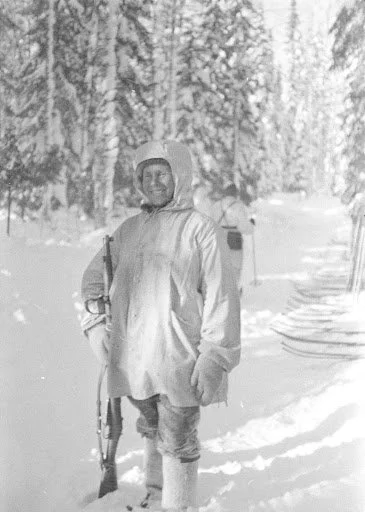
Simo Häyhä, a truly legendary sniper for all you historians. But who was he, and what was his near-mythical story?
Born to Juho and Katriina (née Vilkko) Häyhä on the 17th of December, 1905, Simo grew up with the inseparable love of shooting, snow-skiing, and hunting in the hamlet of Kiiskinen. Located in the Rautjärvi municipality, a region of Karelia, which is now part of Russia, Kiiskinen used to be Finnish territory until ceded to the CCCP due to the Moscow Peace Treaty in 1940 after the loss of the Winter War. Growing up, he constantly hunted, whether it be with family or on his own, sharpening his skills for what he would inevitably have to do… fight in war for the people of his country, the Finnish Democratic Republic.
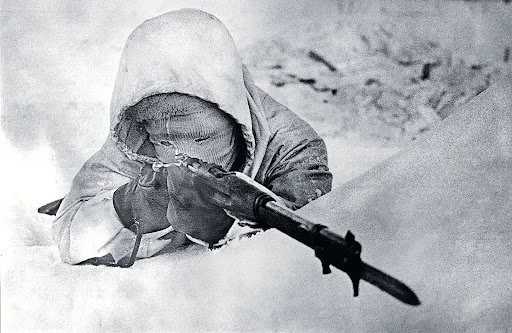
In the war, Häyhä became a threat to be reckoned with, especially for his sharpshooting and marksmanship with a sniper rifle. In fact, he was so famous that in approximately three months, he had a minimum of 505 confirmed kills. The Soviets, fed up with these extraordinary losses by a single man, even began to bomb forests and shoot blindly into the wooden fortress Simo hid in, in attempts of killing, maiming, or revealing the man who killed their troops. In his acts of hiding, he was known as the White Death, both from his extremely impressive kill count and because of his activities. All white clothing, white cotton balaclava, and the standard military apparel beneath, fitting with the standard gloves and boots issued by the Finnish government. Even more terrifyingly, since Simo wanted to maximize his kills while avoiding death, he exchanged the traditional scope for barbaric and archaic iron sights with the claim that a scope's glint can reveal his hidden location while potentially fogging up, and that the scope would force his head to be raised higher, increasing the likelihood of death. To continue his camouflage tactics, he decided to consume snow in order to hide his breath from the Russian invaders.
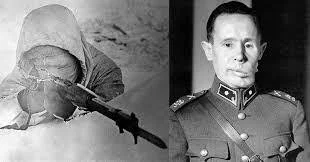
His downfall seemed eons away, but soon enough, his location was revealed, and an explosive bullet exploded in his face. Miraculously, he recovered fully, except for a mutilated jaw. Eventually, Simo lived for another 62 years after the war, enjoying his life calmly in southeastern Finland in Valkjärvi (Whitelake), Ruokolahti, with his hunting lifestyle with his dog Kille.
Questions arise from such a unique story experience, such as what it even means to a life like mine?? Well, to some, it could be the act of taking away ordinary human instincts, in replacement of abnormal and unorthodox extremes: coming up with solutions under stress, expectations, and sheer survival. A belief in a true discipline may also be the driver of many potential actions one may take. The White Death has learned through harsh, grueling times, enduring what many would never expect themselves to encounter, and yet prevailing at such. Maybe a common idea is that enduring what is challenging for a greater reward in the long run is what people prioritize. Most importantly, however, it doesn’t come from what was faced at the start, but rather the calm after the storm. You see, the act of silence was what many call “silent and deadly”, both in his time of war and after chasing the Greco-Roman philosophy of stoicism or achieving eudaimonia (the pursuit of happiness).
So while many may prioritize the glory or fame from the mimicry of such brave, legendary, or outright heroic action, a genuine idea one should follow would be to endure the buildup of a situation, and employ each action taken with true appreciation, dedication, and respect before, during, and after such action.
Works Cited
Anderson, Ronald. “Finnish Sniper Simo Häyhä.” Finnish Sniper Simo Häyhä, Warfare History Network, 2024, https://warfarehistorynetwork.com/article/finnish-sniper-simo-hayha/. Accessed 27 March 2026.
Bontemps, Arna. “Simo Häyhä.” Wikipedia, https://en.wikipedia.org/wiki/Simo_H%C3%A4yh%C3%A4. Accessed 21 February 2026.
Bontemps, Arna. “Simo Häyhä.” Wikipedia, https://en.wikipedia.org/wiki/Simo_H%C3%A4yh%C3%A4. Accessed 27 March 2026.
“Russo-Finnish War | Summary, Combatants, & Facts.” Britannica, 2 January 2026, https://www.britannica.com/event/Russo-Finnish-War. Accessed 21 February 2026.
“Simo Häyhä is widely considered the most lethal sniper in history. He took out hundreds of Soviet soldiers during the Russo Finnish War of 1939 to 1940. Häyhä grew up in Finland near the Russian border and worked as a farmer. He spent most of his youth ...” Facebook, 12 December 2025, https://www.facebook.com/Historical.Season/posts/simo-h%C3%A4yh%C3%A4-is-widely-considered-the-most-lethal-sniper-in-history-he-took-out-hu/1409957227360505/. Accessed 27 March 2026.
“USSR and Finland signed the Moscow Treaty.” USSR and Finland signed the Moscow Treaty, 12 March 1940, https://www.prlib.ru/en/history/619090. Accessed 21 February 2026.
“What Is Stoicism? A Definition & 9 Stoic Exercises To Get You Started.” Daily Stoic, https://dailystoic.com/what-is-stoicism-a-definition-3-stoic-exercises-to-get-you-started/. Accessed 28 February 2026.
“Who Was Simo Häyhä, The Deadliest Sniper in History? | HistoryExtra.” History Extra, https://www.historyextra.com/period/second-world-war/worlds-deadliest-sniper-simo-hayha-finnish-white-death-winter-war/. Accessed 21 February 2026.