

Classic Anne, but with an E

“It doesn’t make sense that girls aren’t allowed to do farm work when girls can do anything a boy can do and even more.”
Throughout her entire childhood, famous author Lucy M. Montgomery’s life had been filled with nothing but loneliness. When she was only 21 months old, her mother died of tuberculosis. Heartbroken by the loss of his wife, Lucy’s father would place her in the care of her grandparents and leave her to start a new family.
Living in Cavendish, Prince Edward's Island with her strict, unaffectionate maternal grandparents was the first obstacle she had to overcome. She was orphaned, trapped, and had no one to talk to. Her relatives lived nearby, but she didn’t have any friends. She coped by creating imaginary friends, named Katie Maurice and Lucy Gray, and spent days out in nature, fostering her love for creativity and imagination.
However, even her aspirations of becoming a writer came as a difficulty for her. The cultural norms during the 1800s barred women from attending college or even becoming authors. Hiding her gender under her pen name, L. M. Montgomery, Lucy published hundreds of works in hopes of sharing her crafts with the world. One work in particular caught the eye of the public.
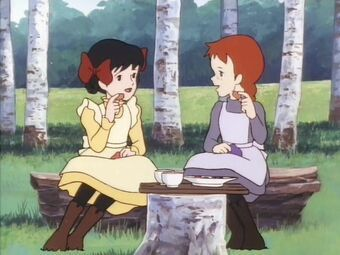
After its initial release in 1908, Anne of Green Gables became an immediate bestseller, selling more than 19,000 copies in the first five months. Even after her death, her work inspired countless adaptations, continuing to sell up to 50 million copies all around the world. The story of a young orphaned girl, inspired by Lucy´s own imaginative childhood, became a classic celebrated by children of all ages, from the Americas to Europe, even to East Asia.
One of the most popular adaptations of Anne was the 1979 Japanese animation of Anne of Green Gables. Through old TV screens, thousands of little girls in Japan and Korea would wait for the newest episode to air, including my mom. Throughout the years, I distinctly remember my mom mentioning Anne Shirley as a key role model in her childhood nonstop.
And the day came when I first started watching the Netflix adaptation, Anne with an E. Yet another Anne story with the same storyline, the same characters, and the same countryside neighborhood Anne played in. And yet, there was something that the others did not have. Sure, Anne was still classic Anne, with bright red hair and a freckled nose. She was still just as talkative as before. She was witty, imaginative, and came across as annoying to her classmates, who constantly bullied her.
But this version of Anne reflected the ability to carry and advocate for our own ideas and beliefs, despite the struggles of being (1) a girl, (2) a young teen at the age of 13, and (3) living in a conservative little town in the late 1800s.
Anne with an E brought back the classics of bright, lively Anne, while mixing modern controversies that wouldn’t have been considered in that time period. The show contains topics of LGBTQ+, feminism, racism, social justice, and freedom of speech, while connecting them with the experience of being purely a teenager, as well as a sense of belonging with found family. Although she grew up as an orphan without a stable home environment, she never once gave up on being purely herself, standing up for what she believed was right.
One of my favorite scenes in the beginning part of the show is the way she spoke her thoughts and advocated for her rights against her (temporary) adoptive mother, Marilla. When told she could not do farmwork because she was a girl and it was “not the way of things,” she boldly retorted, “But couldn’t I? I’m as strong as a boy, and I prefer to be outdoors instead of cooped up in a kitchen. I don’t understand the conundrum. For example, what if suddenly there were no boys in the world? It doesn’t make sense that girls aren’t allowed to do farm work when girls can do anything a boy can do and even more. Do you consider yourself delicate and incapable? Because I certainly don’t.”
Throughout the coming episodes, Anne slowly begins to transform static, traditional values into progressive thinking within those around her through actively challenging norms and speaking her truth in her student-run newspaper.
Side note, feeling second-hand embarrassment while watching is inevitable (especially during the first few episodes), but part of the reason why I think those scenes are hard to watch is because we position ourselves in her, sometimes being reminded of our own embarrassing moments where we said the wrong thing or talked too much. However, I believe this brings the pure, raw experience of being a teenager into life. Going through puberty, we may feel our emotions influencing most of our actions, and this is reflected in Anne’s rash, bold decisions.
Though unfortunately, the show was canceled after season 3, through its short time on screen, Anne with an E carries on the legacy of the original Anne Shirley of Green Gables, mixing it with beautiful, modern filmmaking and themes of developing our own identity.
